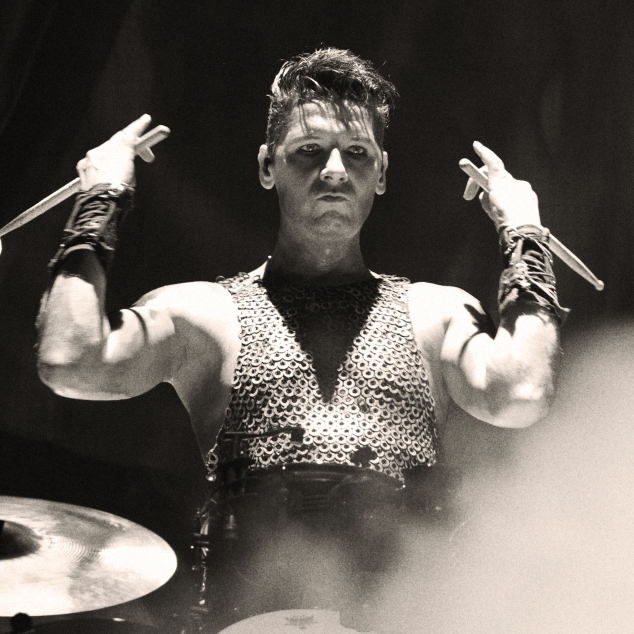
Rammstein’s Drummer Says Beginners Should Avoid This One Big Mistake
Christoph Schneider has been the rhythmic engine of Rammstein since the band formed in the mid-90s. His drumming is known for its precision, its mechanical punch, and its ability to drive some of the largest live shows on the planet. He’s played everything from beat-up beginner kits to fully engineered touring rigs.
So when he gives advice to beginners, it comes from decades of trial, error, and real-world experience — not idealized theory.
Schneider’s biggest warning for new drummers is surprisingly straightforward:
Don’t waste time obsessing over getting the perfect kit or trying to sound “right” through equipment alone.
Many beginners get stuck believing they can’t really improve without upgrading their drums, cymbals, pedals, or sticks. Schneider says that mindset is a trap. When you focus on gear too early, you shift the emphasis away from the real foundations of drumming: rhythm, feel, timing, and control.
He has openly said that his first kit was nothing special — in fact, it was cheap, flawed, and far from ideal. But that’s exactly what forced him to develop musicality rather than chasing fancy equipment. He learned how to make sound rather than relying on gear to improve it for him.
His message is simple:
Your hands matter far more than your hardware.
Another misconception Schneider sees among beginners is the frantic belief that they need to master every style or outplay every drummer they see online. With social media full of players doing blazing fills and gravity-defying techniques, it’s easy to feel inadequate.
Schneider insists that this pressure is pointless. Music isn’t a competition, and a drummer’s goal isn’t to become a human drum machine — it’s to find a voice and a style that feels authentic.
You don’t need to be the best drummer on the internet.
You only need to be the drummer who fits the music you love.
This mindset shift can be liberating, especially for new players who feel paralyzed by comparison.
One of the most refreshing parts of Schneider’s philosophy is his appreciation for simplicity. Over the years, especially as Rammstein adopted click tracks and synchronized elements, he intentionally reduced the complexity of his parts.
Not because he lacked skill — but because the band needed consistency, clarity, and power.
He has talked about experimenting with more complex fills or patterns, only for the band to collectively push back, reminding him that the heartbeat of Rammstein must be solid and unwavering. That experience taught him that sometimes the most musical choice a drummer can make is the simplest one.
For beginners, this is invaluable advice:
Master the basics before you chase the flash.
Solid timing, steady grooves, and dynamic awareness are far more important than fast fills.
Schneider often emphasizes that drummers aren’t just timekeepers, nor are they meant to be show-offs detached from the band’s overall sound. Their job is to support the music — to create a foundation that allows everything else to stand strong.
A drummer who listens, adapts, and plays for the song is worth far more to a band than someone who focuses only on technical display.
This perspective often runs counter to online drumming culture, where individual performance is the focus. But for real musicianship, Schneider’s approach is timeless.
In a world where beginners are constantly presented with:
-
expensive gear setups
-
hyper-technical online drummers
-
tutorials pushing advanced techniques
-
pressure to “catch up” as quickly as possible
Schneider’s grounded, realistic advice is a breath of fresh air.
He reminds new drummers that:
-
Great musicianship grows from practice, not purchases.
-
Creativity matters more than complexity.
-
Musical feel is more important than technical perfection.
-
You don’t need ideal conditions to start — you just need willingness.
This mirrors what many veteran drummers say: gear is fun, but skill is built with your body, not your wallet.
What Beginners Should Do Instead
Inspired by Schneider’s philosophy, here’s what new drummers should focus on:
1. Start with whatever equipment you have
Don’t wait for upgrades. You can learn rhythm, control, and coordination on almost anything — even practice pads or an old kit.
2. Prioritize timing and groove
Use a metronome. Start slow. Develop stability before speed.
3. Listen to music closely
Study how drums interact with the rest of a song. Learn to appreciate placement, dynamics, and feel.
4. Play with others whenever possible
Nothing teaches musicianship like real collaboration.
5. Don’t compare yourself to drummers online
Their highlight reels don’t represent your starting point. Everyone’s journey is different.
6. Focus on fun and curiosity
Drumming is supposed to feel good — that’s why you started.